Inkling: the transformer that loops
← back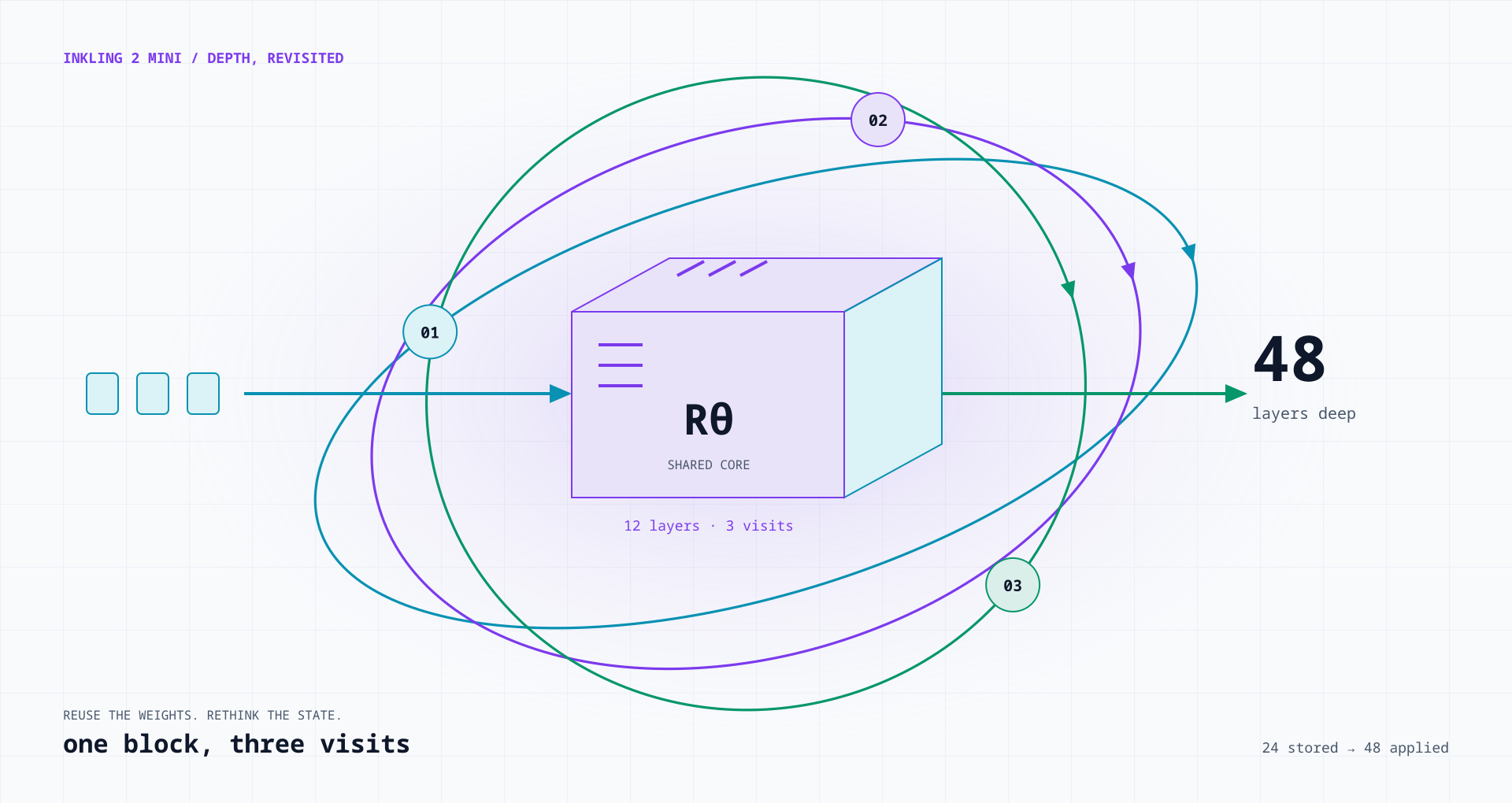
Contents
- 1. Three ways to spend compute
- 2. The loop, precisely
- 3. Some notations before we begin
- 4. Opening the loop: inside Inkling 2 Mini
- 4.1. The map
- 4.2. Visit #1
- 4.3. The restart
- 4.4. The messages
- 4.5. What does NOT loop
- 5. Wait, which Inkling loops?
- 6. Does looping actually work?
- 7. What the hype hides
- 8. End note
- 9. References
In my previous blogs we saw how RNNs looped the same cell over time, how LSTMs learned to control that loop with gates, and how transformers threw the loop away entirely: every token processed in parallel, every layer with its own weights. That trade gave us the modern era.
On 20 November 2026, Thinking Machines Lab shipped Inkling 2 Mini, and the loop came back. Not over time. Over depth. One shared block of layers, visited three times by every token, before the token is allowed to exist.
Personally, the small Nx in the transformer diagram always bugged me. "Just repeat this block N times", sure, but why does each repetition need its own weights? What if the same block could look at its own work and take another pass? That is exactly what Inkling does, and in this blog we will open it up piece by piece.
Inkling 2 Mini stores 24 layers but executes 48 layer-applications per token: a 12-layer "core" block reused 3 times. Same weights, fresh state, learned notes passed between visits. It thinks twice (well, thrice) before it speaks.
Three ways to spend compute
Before the architecture, let us build the intuition. Making a model better really means choosing between three budgets:
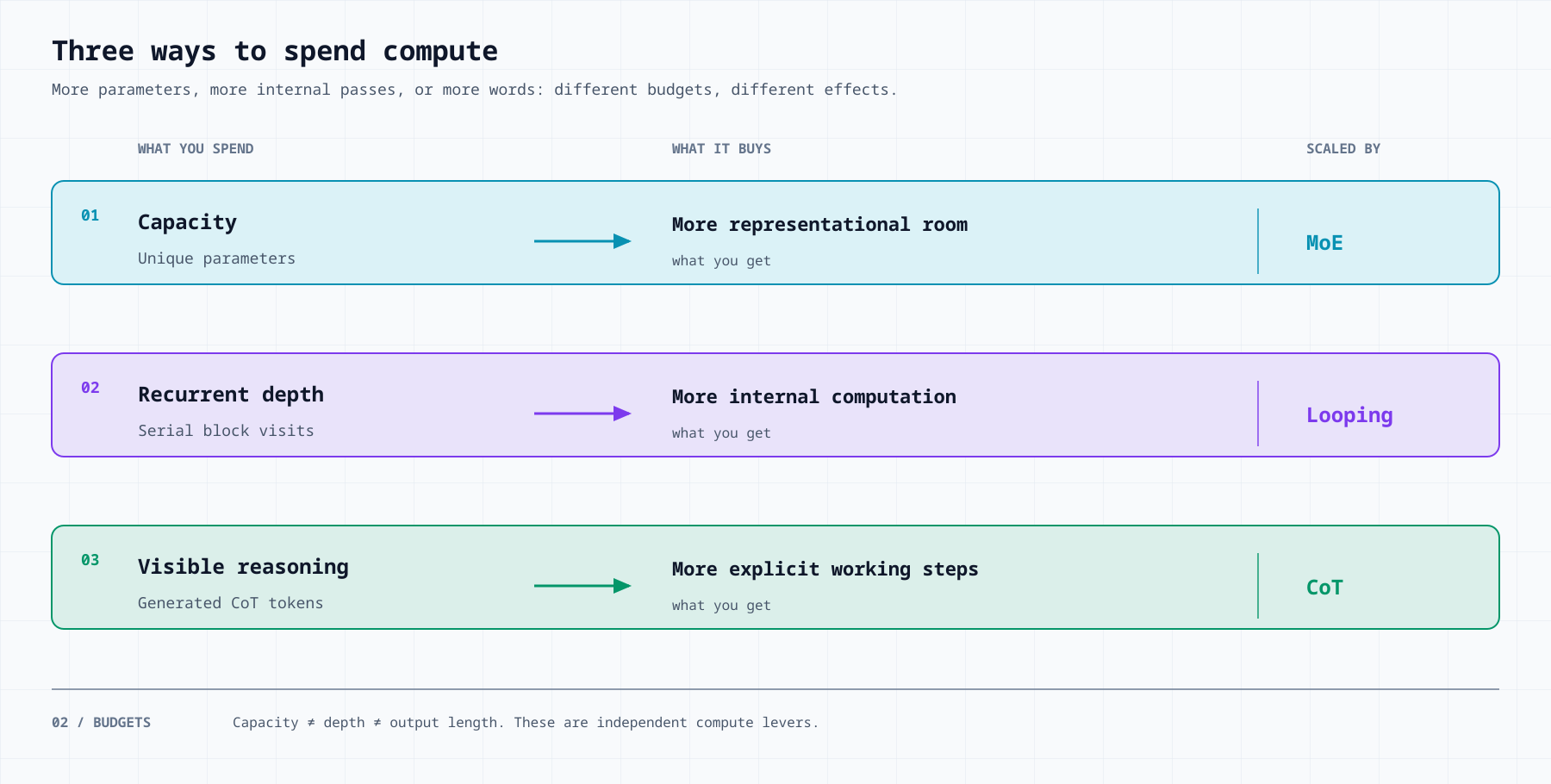
- Capacity: more unique parameters. More facts, more procedures, more storage. This is what MoE scales cheaply: huge weight count, only a slice active per token.
- Recurrent depth: more sequential transformations of the same hidden state. Not more storage, more manipulation of what is already represented. This is what looping scales.
- Visible reasoning: more generated tokens. Chain-of-thought. The model literally writes its intermediate work where you can read it.
Every "our model is smarter now" announcement is spending on one or more of these axes. They are not interchangeable: capacity buys knowledge, depth buys manipulation, visible reasoning buys inspectability. Keep this triangle in mind: everything Inkling does is a bet on axis #2.
When a vendor says "smaller model, same performance", always ask which budget was held fixed. Stored weights, inference FLOPs, latency and quality are four different numbers.
The loop, precisely
Time for the primitive of this post. Everything else is decoration on top of this one idea.
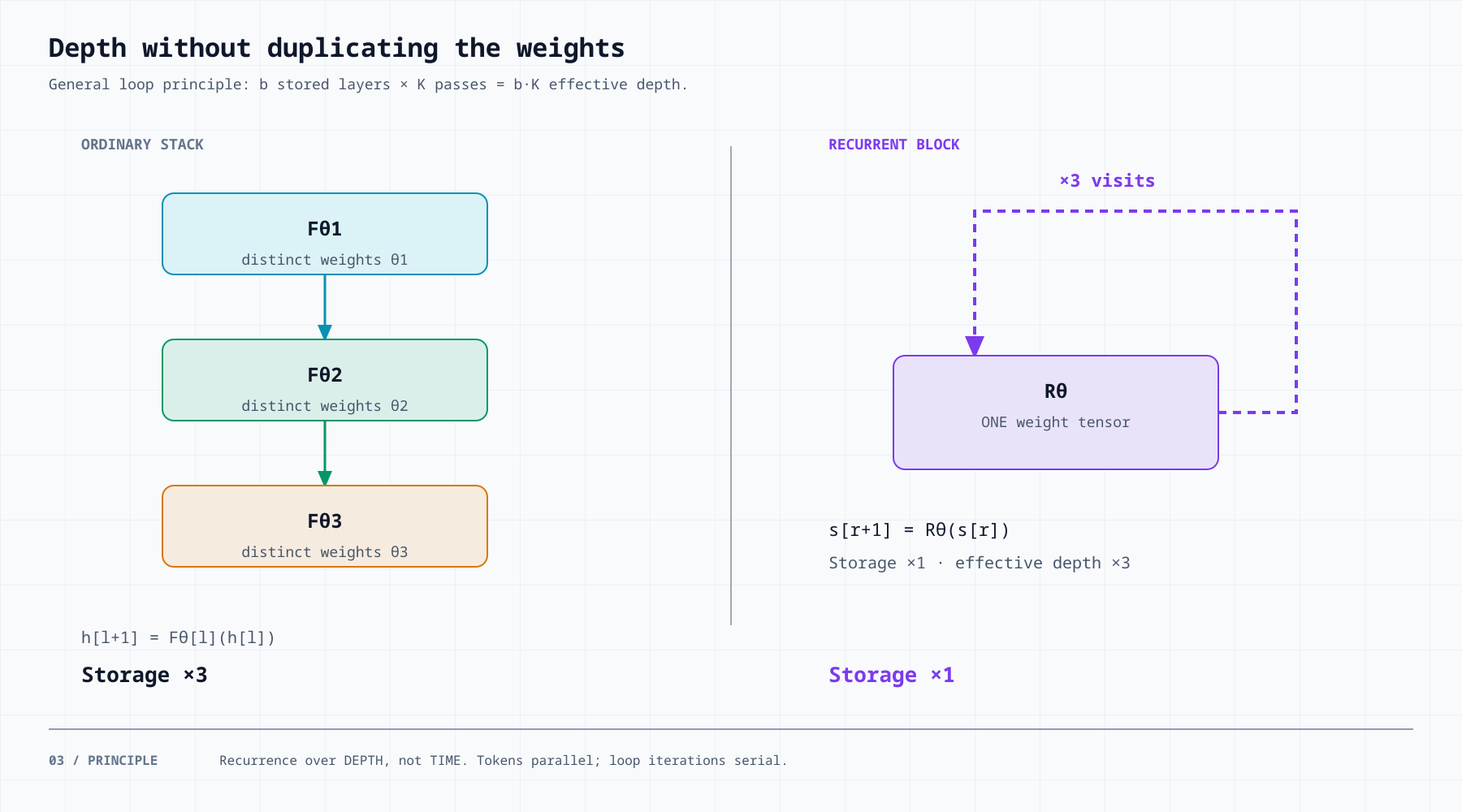
An ordinary transformer stack computes:
Every depth has its own parameters . A 48-layer model stores 48 different sets of weights. A loop transformer computes:
The same at every step. Store one block, apply it times, get times the effective depth.
Now the part that matters, and where most explanations go wrong:
This is recurrence over depth, not over time. In an RNN, token waited for token ; that is why training could not parallelize. In a loop transformer, all tokens still move through the block in parallel. What is serial is the loop itself: visit needs the state produced by visit . The old RNN bottleneck did not disappear. It moved to a different dimension and got much shorter (3 steps, not 10,000).
The RNN idea was one cell, reused at every timestep. Replace "timestep" with "visit" and you already understand loop transformers. The rest of this post is how Inkling wires it.
Some notations before we begin
| Symbol | Meaning |
|---|---|
| Prelude: first 6 layers, run once. Encodes the problem. | |
| Saved state: hidden state right after the prelude. Snapshotted. | |
| Core: 12 shared layers, visited times. | |
| Hidden state at visit . | |
| Coda: last 6 layers, run once. Turns state into logits. | |
| Number of visits. Fixed at 3 for Inkling 2 Mini. | |
| Messages: learned notes passed from visit to visit . |
The full pipeline, mathematically:
Prelude encodes, core iterates, coda speaks. Simple skeleton, but the wiring inside is where Inkling gets interesting.
Opening the loop: inside Inkling 2 Mini
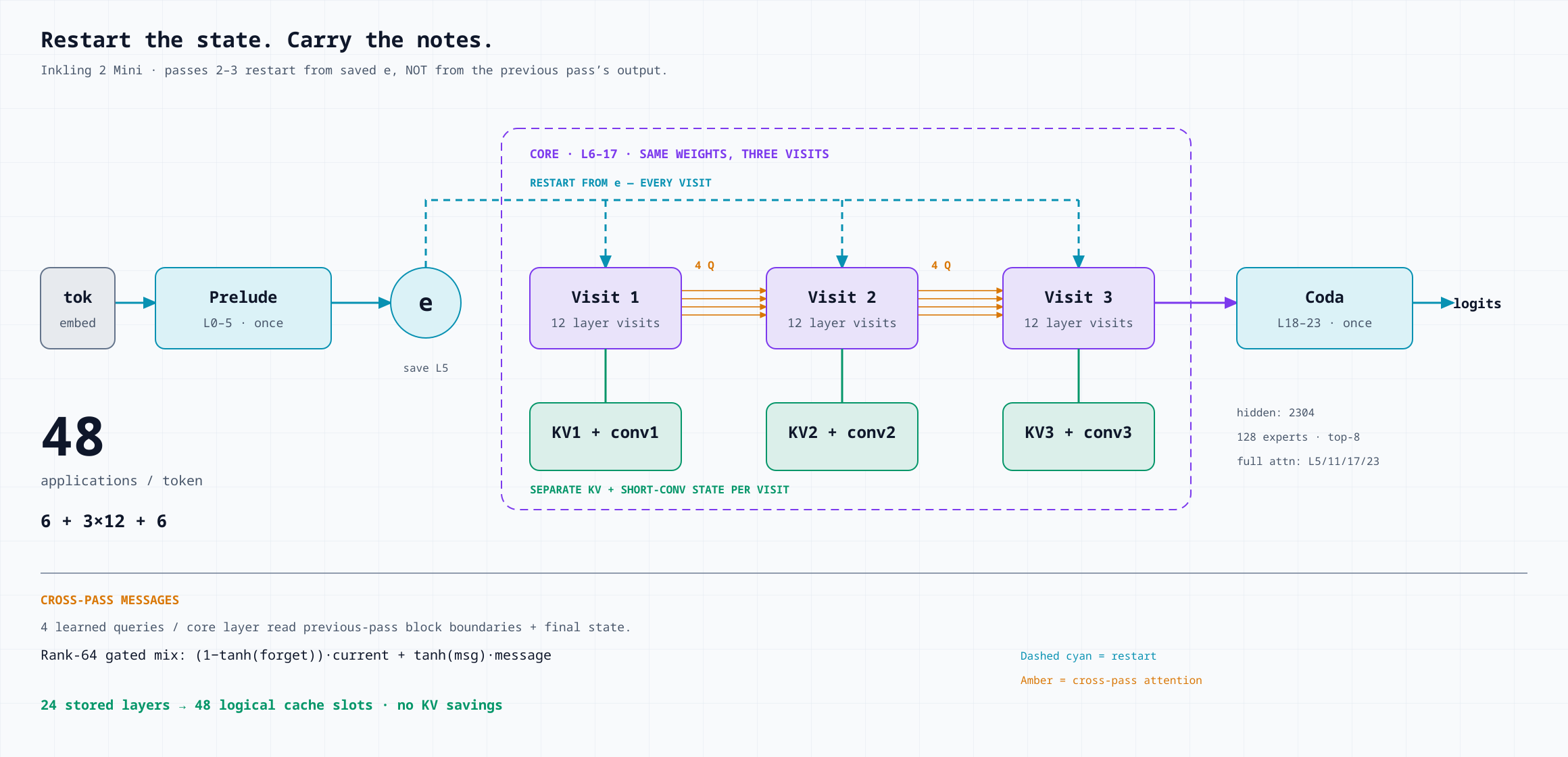
Here is the complete path of a single token. Take a breath, look at the diagram, and then we walk it visit by visit.
The map
Inkling 2 Mini stores 24 decoder layers:
- layers 0–5: prelude, executed once
- layers 6–17: core, executed three times
- layers 18–23: coda, executed once
The model card reports 26.4B total parameters, 3.4B unique active. You will see "5.4B effective active" floating around: that is the 3.4B plus the repeated re-reads of the shared core at 3 visits. It is an operation count, not extra stored weights. First lesson of reading loop-transformer marketing: stored bytes and executed FLOPs are different currencies.
Visit #1
The token enters the prelude, and the prelude does something unusual: after layer 5, the hidden state is snapshotted. Call it , the encoded problem statement.
Then the core runs for the first time: 12 layers of attention + MoE over . Hidden width 2304, 128 routed experts with top-8 routing, full attention at layers 5, 11, 17 and 23. The output of visit #1 is , a first draft of "thinking".
In a naive loop design, would feed straight back in. Inkling does something subtler.
The restart
Here is the surprise: visits #2 and #3 do not continue from the previous visit's output. They restart from the saved state (the post-prelude snapshot) and receive the previous visit's work only as messages.
Think of it like re-attempting a problem from the original question each time, while keeping your previous attempt's margin notes, not continuing to scribble on top of the old attempt. This keeps every visit anchored to the actual problem and prevents errors from compounding through chained states.
The messages
So what are these margin notes? At every core layer, 4 learned query vectors attend over the previous visit's block-boundary states (plus its final state) and produce messages, separate ones for the Q, K, V, and MoE inputs of the current visit.
Each message is merged with the current state through a gated mix:
where and are small rank-64 learned projections. If your LSTM senses are tingling, they should be. This is a forget gate. The same -squashed knob that decided what to remember in a cell state now decides how much of the previous visit's notes to let into the current visit. The gates escaped the cell and got promoted to depth.
The gates reportedly start closed and open during training. The model literally learns how much to listen to its previous attempt.
What does NOT loop
Here is where "shared weights" stops sounding free. Two things re-run fresh on every visit:
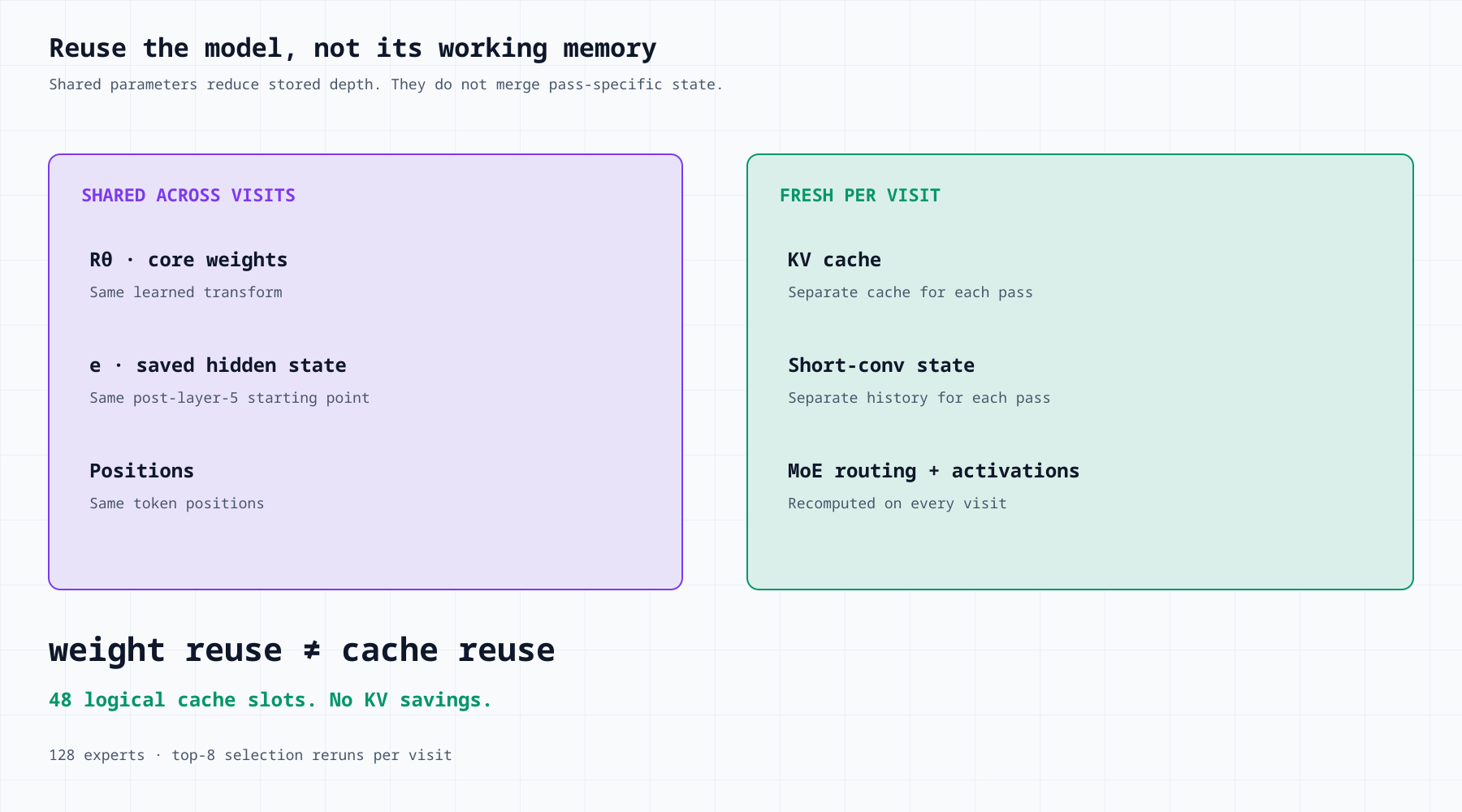
- Routing. The MoE router re-decides expert assignment on every visit. A token can consult different experts on visit #2 than it did on visit #1: same weights, different path through them.
- Cache state. Each logical layer-application keeps its own KV cache and convolution state: 48 logical cache slots, not 24. Shared weights do not mean shared memory. At long context, Inkling's weight savings do not translate into proportional KV savings.
"26B model" is the storage number. It still executes 48 layer-applications and keeps 48 layers' worth of cache per token. Compute, latency and memory bandwidth did not shrink by 3×. Only the weights did.
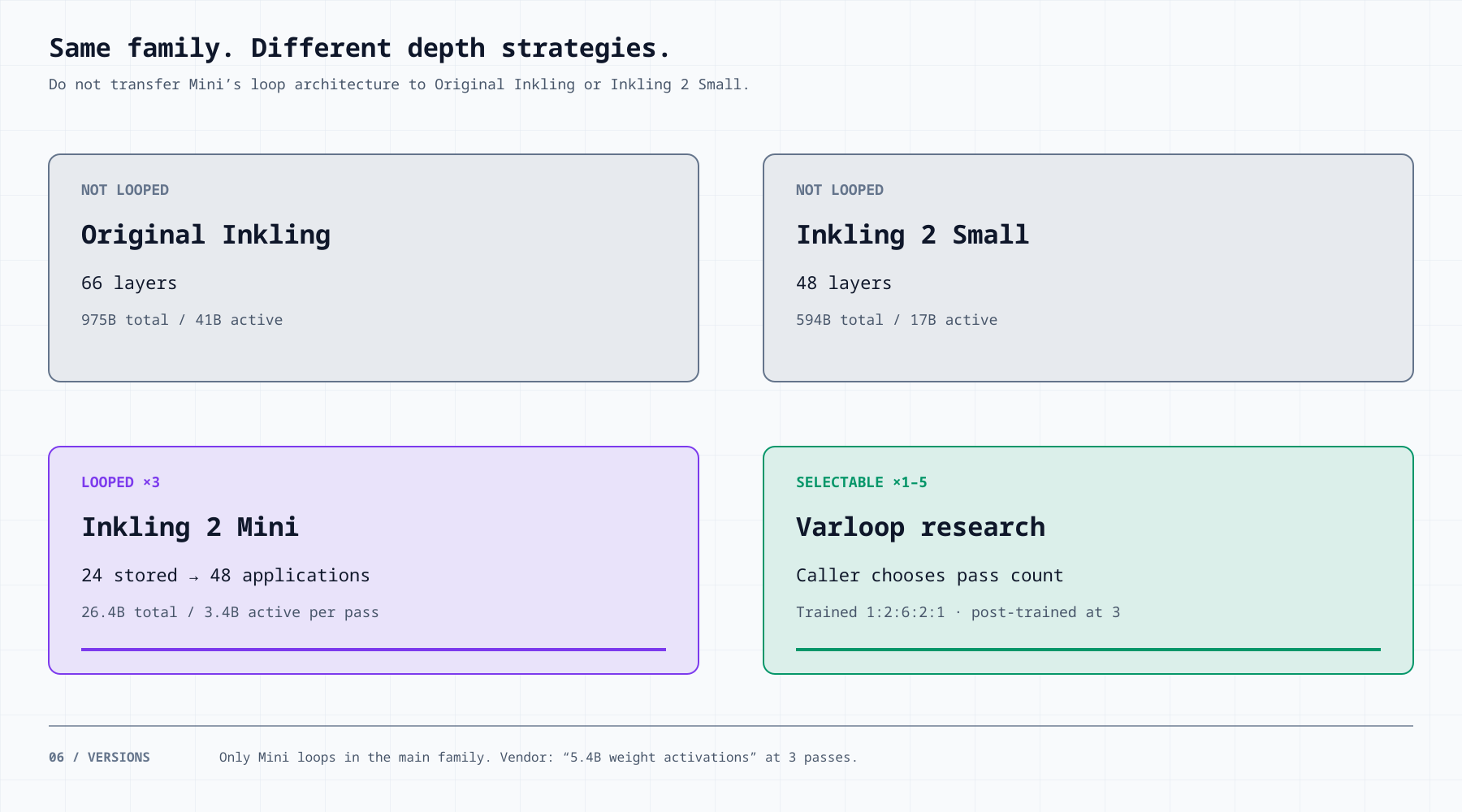
Wait, which Inkling loops?
This needs its own section, because the internet got it wrong within hours of release.
| Model | Loops? | Architecture |
|---|---|---|
| Original Inkling | No | 66-layer conventional sparse MoE, 975B total / 41B active |
| Inkling 2 Small | No | 48-layer conventional MoE, 594B / 17B |
| Inkling 2 Mini | Yes, ×3 fixed | 24 layers → 48 applications, 26.4B / 3.4B |
TML-d24-varloop-research | ×1–5, caller's choice | Same topology, trained across depths |
The first two are ordinary, if very good, transformers. The Mini is the looped one. And that last row is the quiet gem: an open research checkpoint where you pick the number of visits at inference time. It was trained with passes sampled 1:2:6:2:1 (so it saw 3 most often), and it turns "how many times should the model think about this?" into a runtime dial.
Does looping actually work?
Everything above is mechanism, source-verified in the public config and the Transformers implementation. Everything below is vendor-reported, not independently reproduced. With that honesty up front:
Looped beats unlooped at matched compute. Thinking Machines trained a non-looped sibling and compared at equal executed compute: the looped variant won 27 of 28 evaluations, with a compute-equivalent gain of 1.51–1.91×. The non-loop variant needed 140% more inference compute to match the looped loss on agentic traces.
More visits help, then stop helping. The varloop checkpoint is the cleanest evidence, because the same weights run at different depths:
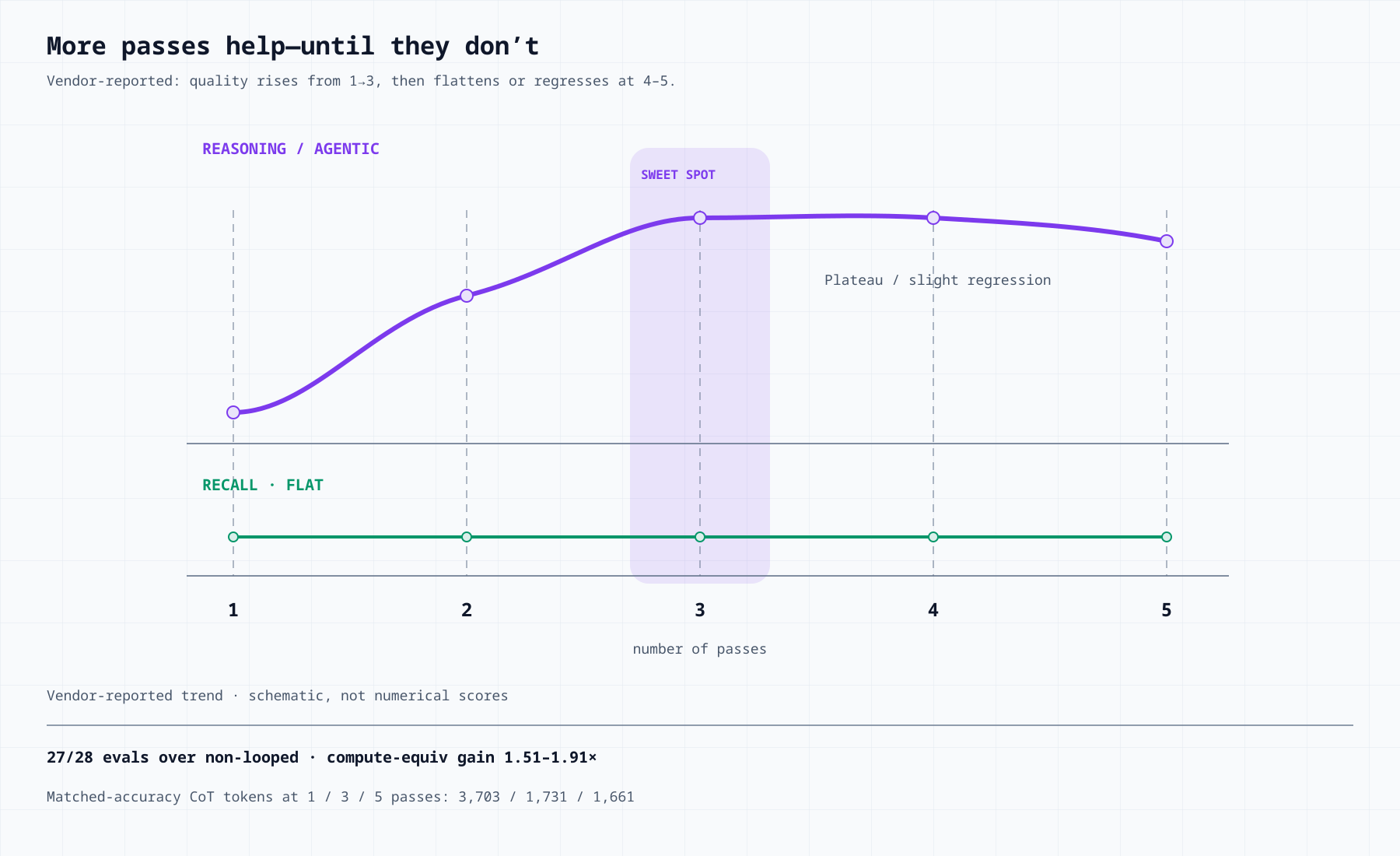
- Reasoning, agentic and long-context tasks improve sharply from 1 → 3 visits.
- At 4–5 visits, gains flatten, wobble, or regress.
- Recall-heavy tasks barely move at any depth. Loops help manipulation, not storage, exactly what the three-budgets picture predicted.
Loops eat chain-of-thought. At matched accuracy, mean reasoning tokens went 3,703 → 1,731 → 1,661 at 1, 3 and 5 visits. The "thinking" migrates from visible tokens into hidden iterations. On a no-CoT task suite, the effective task horizon stretched from 16 to 37 "human-seconds" between 1 and 3 visits.
Same accuracy with ~half the visible reasoning tokens means cheaper and faster agents. But it also means the model's reasoning is no longer written down anywhere you can read it. More on that in a moment.
What the hype hides
Let us be the adults in the room, because the headlines will not be.
Parameter efficiency ≠ compute efficiency. Looping a block three times stores it once and executes it three times. The latency of 48 serial layer-applications is the latency of 48 serial layer-applications. Smaller resident weights help bandwidth-bound decoding, and shorter chains-of-thought reduce total task time, but per-token compute goes up, not down.
More loops is not a dial to infinity. Benefits saturate at 2–4 visits and can reverse. A model trained across 1–5 visits is not licensed to run at 50. Depth extrapolation is learned behavior, not a theorem.
The RNN ghost. Visit needs visit 's state. That dependency cannot be parallelized away: the exact same wall that ended the RNN era, now over depth. It is a much shorter wall (3 steps), but it is load-bearing: loop transformers will always pay a serial tax that an untied deep model does not.
Oversight tension. Chain-of-thought's one undeniable virtue is that you can read it. Every unit of reasoning that moves into latent iterations is a unit of reasoning your safety tooling cannot see. Thinking Machines reports "no detected decline in monitorability", which is careful, honest phrasing for we looked and didn't find anything, not there is nothing to find.
Evidence maturity. Topology and wiring: verified in public code. Quality, speed, and monitorability numbers: vendor experiments, valuable but unreproduced. The honest summary is "real architecture, promising early numbers, jury still out".
End note
Here is the whole post in one picture:
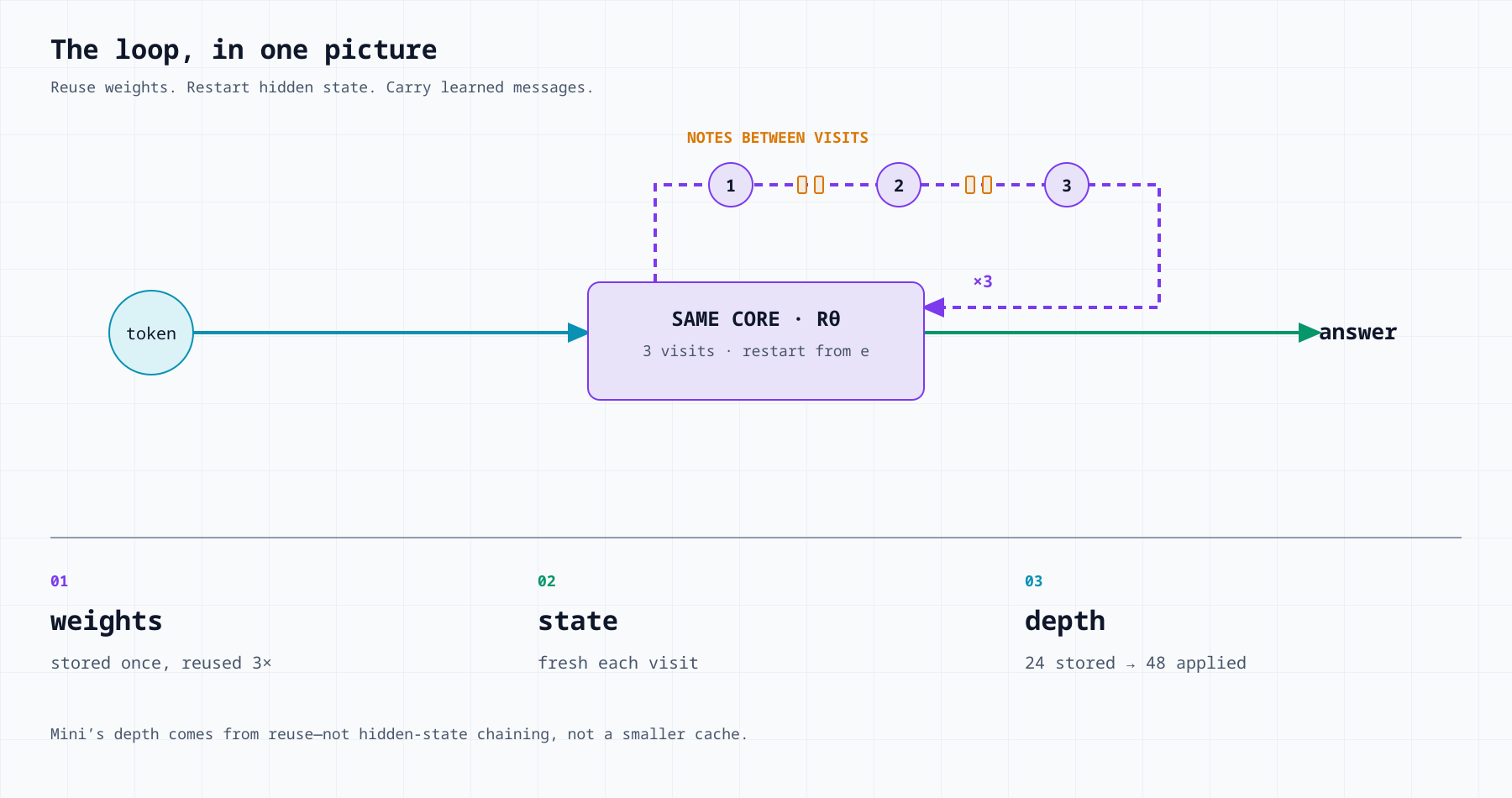
And in one paragraph: RNNs looped one cell over time, and we loved them until the serial dependency became unbearable. Transformers unrolled the loop, gave every layer its own weights, and parallelized everything. Inkling loops one block over depth, restarting from a saved snapshot, passing gated notes between visits and re-routing experts every time, and gets 48 layers of thinking out of 24 layers of storage. Recurrence never died. It just moved to a dimension where 3 steps of serial dependency is a price worth paying.
The Nx in the diagram finally makes sense to me. I hope it does to you now as well!
Happy learning!
References
- Inkling 2 Mini (Thinking Machines Lab): the announcement that started it all
- Inkling 2 Mini model card + config: where the 6 + 3×12 + 6 arithmetic lives
- Transformers
inkling2_loopimplementation: restart semantics and message gating, in code TML-d24-varloop-researchcheckpoint: the 1–5 visit dial, open weights. Huge shoutout for shipping this- Scaling Test-Time Compute with Latent Reasoning (Geiping et al.): 3.5B recurrent-depth model, the February 2025 catalyst
- Reasoning with Latent Thoughts (Saunshi et al.): loops help reasoning far more than recall
- Ouro: open 1.4B/2.6B looped models on 7.7T tokens
- Universal Transformer (Dehghani et al., 2018): the clearest ancestor; gold standard of "this idea is older than you think"
- Adaptive Computation Time (Graves, 2016): where learned halting began
- Sparse Layers Are Critical (IsoFLOP study): the counterresult that keeps everyone honest